
Part 1 of 2
For many small businesses, the phone is still one of the most important tools in the office. A patient calls a medical office to schedule an appointment. A client calls a professional service firm about a contract. A property owner calls a commercial real estate company about a leasing issue. A vendor calls a manufacturing company about a production delay. In many businesses, one missed call can mean a missed opportunity, a frustrated customer, or a delayed decision.
That is why robocalls, spam calls, scam calls, and unwanted telemarketing calls are more than a daily annoyance. They are an operational cost.
Across the United States, robocall volume remains massive. YouMail estimated that Americans received 52.8 billion robocalls in 2024 and 52.5 billion robocalls in 2025, with annual volume staying near the 50–55 billion range in recent years. The FTC also continues to track unwanted call complaints through the National Do Not Call Registry and shares complaint data with law enforcement.
For small businesses, the real cost is not only the call itself. The cost comes from the interruption, the employee time, the mental disruption, the loss of focus, the delayed customer service, and the possibility that a real client may not get through because the phone line is busy with junk calls.
Why Robocalls Hurt Small Businesses More Than Large Companies
Large companies often have call centers, automated phone systems, IT departments, compliance staff, and dedicated customer service teams. A small business usually does not. In a dental office in Irvine, the front desk may be handling patient check-ins, insurance verification, appointment scheduling, treatment plan questions, and calls from vendors—all at the same time.
In a medical office in Los Angeles, one receptionist may be answering calls from patients, pharmacies, labs, insurance companies, and referral partners. When robocalls interrupt that workflow repeatedly, the cost is not theoretical. It shows up in longer hold times, frustrated patients, delayed callbacks, and unnecessary stress on staff.
A small manufacturing company in Long Beach may not receive the same type of calls as a medical practice, but the interruption still matters. If an office manager is coordinating purchase orders, vendor invoices, production schedules, and delivery timelines, every unwanted call forces that person to stop, evaluate the call, decide whether it is legitimate, and then return to the original task.
That switching cost is real. Research on workplace interruptions shows that interruptions increase stress and workload, even when employees compensate by working faster. The American Psychological Association has also noted that task switching can reduce productive time significantly, especially when people repeatedly shift attention between unrelated tasks.
Estimated Annual Cost of Robocalls for a Small Office
The exact cost depends on call volume, wage rates, staffing structure, and how the office handles incoming calls. But the math becomes serious very quickly.
Let’s assume a small office receives 8 unwanted calls per day. That may sound high to some businesses and low to others, but for many public-facing offices—medical, dental, construction, real estate, legal, accounting, and professional services—it is realistic.
If each unwanted call consumes only 2.5 minutes of direct time, including answering, identifying the call, hanging up, documenting if needed, and mentally returning to the original task, the office loses:
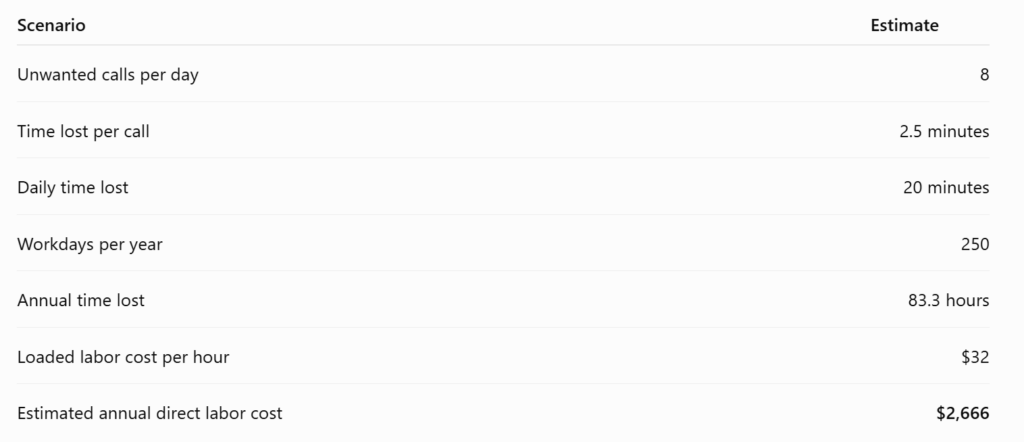
That is only the direct wage cost. It does not include stress, mistakes, missed calls, patient dissatisfaction, lost sales opportunities, or the cost of management time spent trying to fix the problem.
For offices receiving 15 to 25 unwanted calls per day, the cost can easily move into the $5,000 to $10,000+ annual range, especially when the employee answering the phone has higher responsibility, such as an office manager, practice administrator, billing coordinator, or operations lead.
Scenario 1: A Medical Office in Los Angeles
Imagine a small primary care office in Los Angeles with one physician, one medical assistant, and one front-office coordinator. The front-office coordinator answers patient calls, schedules appointments, handles insurance questions, and communicates with pharmacies.
The office receives about 12 unwanted calls per day. Some are extended warranty calls, some are fake insurance calls, some are Medicare-related marketing calls, and some are vague “business financing” or “Google listing” calls.
Each call takes around 2 to 3 minutes to evaluate. That may not sound like much, but the calls often come during peak times: 8:30 a.m., lunch hour, and late afternoon. Those are also the times when real patients are calling.
If this office loses about 30 minutes per day to unwanted calls, that is roughly 125 hours per year. At a loaded labor cost of $35 per hour, the direct annual labor cost is approximately $4,375.
But the real business cost may be higher. If even one new patient per month gives up because the phone is busy or the front desk is overloaded, the practice could lose thousands more in potential revenue.
Scenario 2: A Dental Practice in Irvine
Now consider a dental practice in Irvine with two dentists, three hygienists, and a busy front desk. The office depends heavily on the phone because patients call to schedule cleanings, reschedule appointments, ask about insurance, and follow up on treatment plans.
The practice receives 10 unwanted calls per day. The receptionist has to answer because some legitimate calls may come from patients, labs, insurance carriers, specialists, and vendors. Ignoring unknown numbers is risky.
If each unwanted call consumes 2 minutes, the office loses about 83 hours per year. At $30 per hour, the direct cost is about $2,500 annually. However, dental offices also face another hidden cost: schedule disruption. If the front desk is distracted and fails to confirm an appointment, fill a cancellation, or call back a treatment-plan patient, the opportunity cost may be much higher than the wage cost.
A single missed crown, implant consult, or cosmetic case can exceed the annual direct cost of robocall interruptions.
Scenario 3: A Small Manufacturing Company in Long Beach
A small manufacturing company in Long Beach may not have patients calling, but it still relies on the phone for vendors, logistics, purchase orders, equipment repair, customer service, and delivery coordination.
The office manager receives 8 to 15 unwanted calls per day, many disguised as financing offers, equipment warranties, credit card processing offers, or fake business service calls. The problem is that some real vendors also call from unfamiliar numbers.
The manager cannot simply stop answering the phone.
In this case, robocalls create an operational bottleneck. A delayed vendor call can slow purchasing. A missed logistics call can delay shipment. A distracted office manager can make data-entry mistakes in invoices, purchase orders, or scheduling.
For small production businesses, the cost of robocalls is not only administrative—it can affect workflow, delivery timing, and customer satisfaction.
️ Scenario 4: A Construction Company in Pasadena
A construction company in Pasadena may receive calls from subcontractors, inspectors, clients, suppliers, architects, engineers, and city departments. At the same time, construction companies often receive aggressive calls from financing companies, insurance marketers, warranty sellers, lead-generation services, and scammers.
If the office receives 15 unwanted calls per day, and each call takes 2 minutes, that equals 30 minutes per day or 125 hours per year. At a loaded labor cost of $38 per hour for an experienced project coordinator or office manager, the direct cost is about $4,750 per year.
But the bigger issue is timing. If a project manager misses a legitimate call from an inspector or subcontractor because the line is tied up with a scam call, the cost can become much larger. A small scheduling delay on a construction project can create labor inefficiency, subcontractor frustration, or client dissatisfaction.
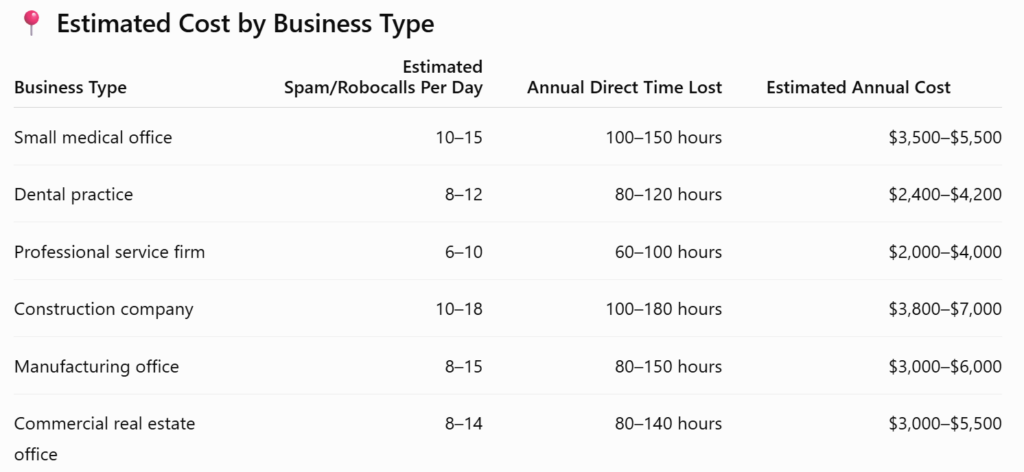
These are not exact numbers for every business. They are practical estimates based on call frequency, administrative time, and labor cost assumptions. The purpose is to show that robocalls are not “free interruptions.” They consume real payroll dollars.
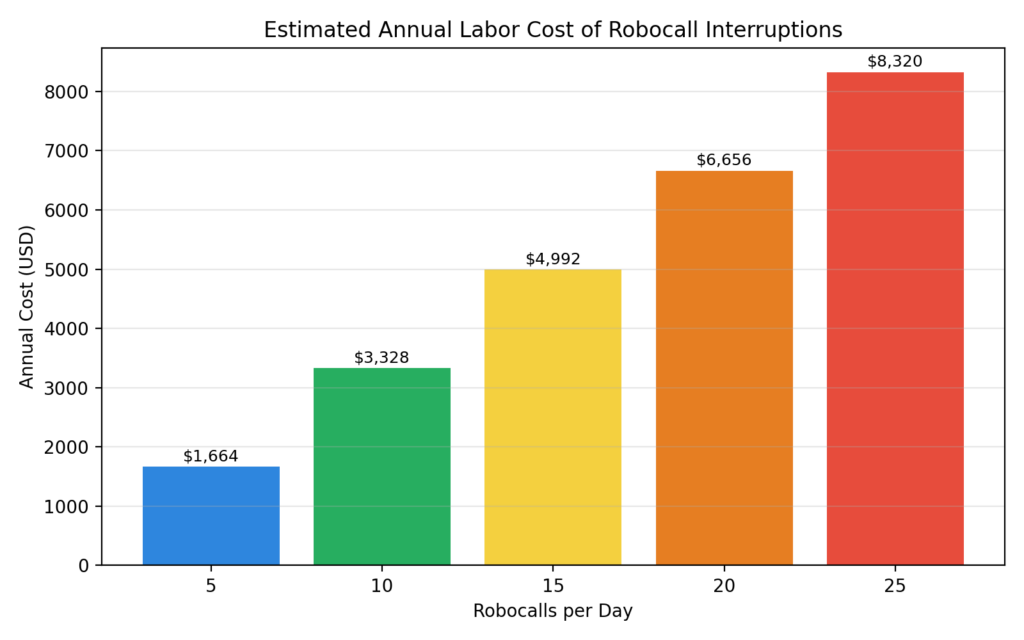
What This Chart Means for Small Businesses
At first glance, a few unwanted calls each day may not seem like a serious problem. However, when those interruptions occur every business day throughout the year, the hidden cost becomes significant. A business receiving just 10 robocalls per day could lose more than $3,300 annually in direct employee time alone. Businesses receiving 20 to 25 unwanted calls per day could lose $6,500 to $8,000 or more before considering lost sales opportunities, customer frustration, employee stress, and reduced productivity.
For many small businesses, that amount is enough to pay for new technology, employee training, marketing campaigns, office equipment, or other investments that contribute to business growth. Instead, those resources are quietly consumed by unnecessary interruptions.
⚠️ The Hidden Costs Most Businesses Do Not Measure
Most business owners notice robocalls, but they rarely measure them. That is the problem. What does not get measured usually does not get managed.
The hidden costs include:
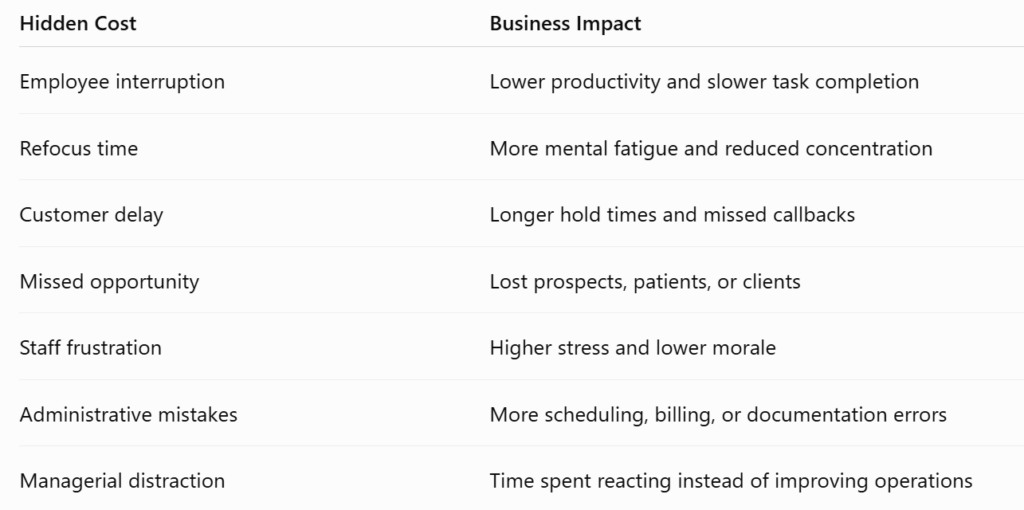
The cost of stress is especially important. Unwanted calls may seem minor individually, but repeated interruptions create a constant feeling of being pulled away from meaningful work. In a busy medical or dental office, that stress can affect how employees speak to patients. In a professional service firm, it can interrupt concentration during client work. In a manufacturing company, it can disrupt coordination and accuracy.
Chart 1: Annual Cost by Robocalls Per Day
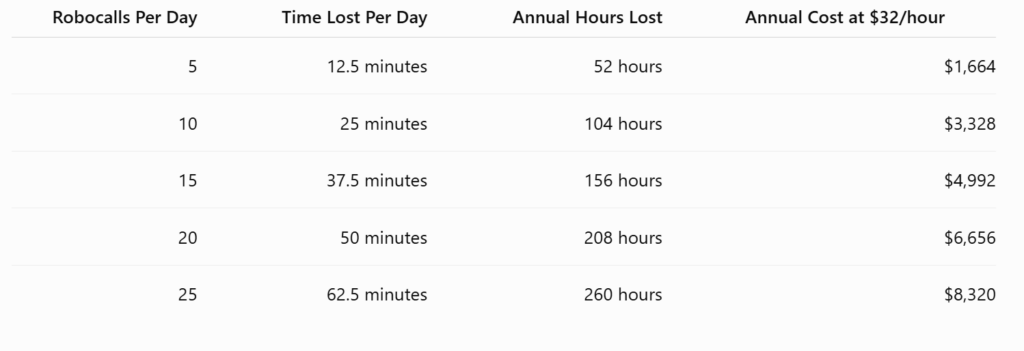
Chart caption: Even a few unwanted calls per day can create thousands of dollars in annual labor cost when interruption time is measured across the full year.
Chart 2: Where the Cost Comes From
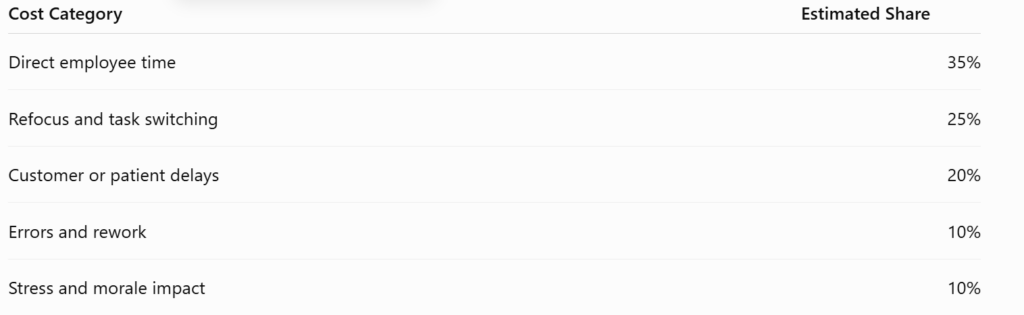
Chart caption: The visible cost of robocalls is only part of the problem. The larger operational cost often comes from interruption, refocus time, and delayed service.
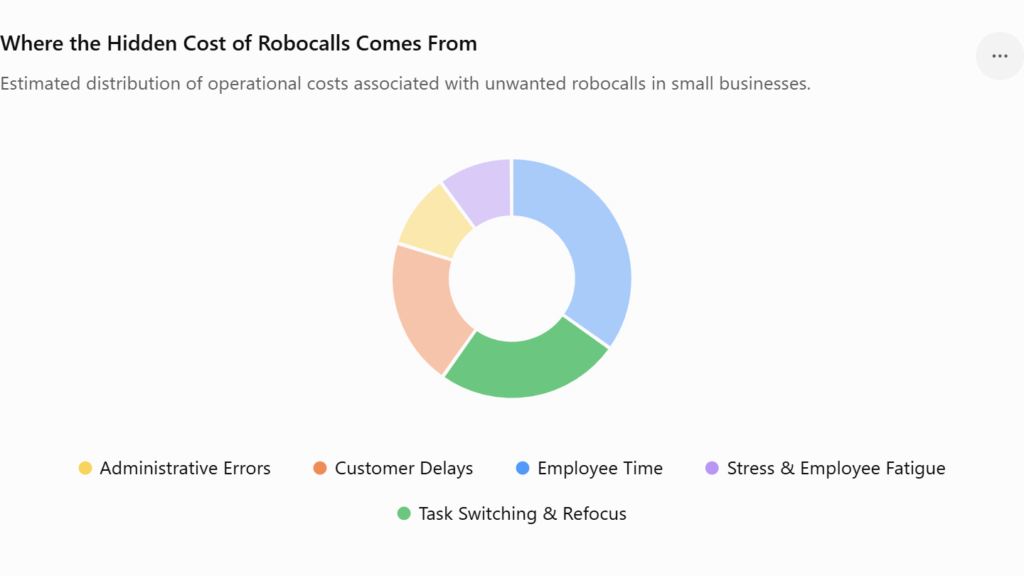
Figure 2. Where the Hidden Cost of Robocalls Comes From
The greatest expense is not the phone call itself. Most of the cost comes from employee time, repeated task switching, delayed customer service, and the cumulative effect of interruptions on productivity and morale. Percentages are illustrative estimates intended to demonstrate the relative impact of each cost category on small businesses.
I think this chart works well because it tells a different story than the first one. The bar chart answers “How much does it cost?” while this pie chart answers “Why does it cost so much?” Together, they make a strong visual case before you move into the real-world scenarios.
Important Note: Robocalls Are Different From Scam Emails
This article focuses on robocalls, unwanted phone calls, and spam calls. Scam emails, phishing links, fake invoices, and malicious attachments are a separate problem. They also create serious business risk, but the operational pattern is different.
Robocalls interrupt the business in real time. They ring the phone, demand immediate attention, and interfere with live customer service.
Scam emails and phishing messages create a different workflow problem. Employees may spend time reviewing suspicious emails, forwarding them to managers, checking links, or asking whether an invoice is real. The risk can include data theft, wire fraud, malware, and credential compromise.
Both problems matter, but they should be analyzed separately. A robocall reduction strategy should focus on phone systems, call routing, caller ID protection, call screening, and staff procedures. An email fraud strategy should focus on cybersecurity, employee training, email filtering, payment controls, and verification processes.
What Can Small Businesses Actually Do?
Reporting unwanted calls to the FTC or FCC is useful, but it is not enough by itself. The FCC provides guidance for reporting unwanted calls and texts, and the FTC collects Do Not Call and robocall complaint data. But small businesses need practical operational solutions inside their own systems.
1. Install a modern business phone system
Many small businesses still operate with outdated phone systems that do not provide adequate call filtering, routing, call analytics, or voicemail handling. A modern VoIP system can help screen calls, route known callers, block repeated spam numbers, and provide call logs that allow management to identify patterns.
2. Use AI call screening carefully
AI call screening can help reduce interruptions by asking callers to identify themselves before reaching staff. This can be useful for non-urgent lines, general inquiry numbers, after-hours calls, and administrative departments. However, medical and dental offices must be careful not to create barriers for patients, emergency calls, pharmacies, referral partners, or older patients who may struggle with automated systems.
3. Separate public-facing and priority phone lines
A small business may need more than one phone number. For example, a medical office can separate general inquiries from provider lines, pharmacy lines, billing lines, or referral lines. A construction company can separate vendor calls from client calls. A commercial real estate office can separate leasing inquiries from internal operations.
This reduces the risk that robocalls will disrupt the most important communication channels.
4. Create a call-handling protocol
Employees should know what to do when they receive suspicious calls. A simple call-handling protocol can reduce wasted time. For example, staff can be trained not to engage with unknown sales calls, not to press numbers, not to confirm business information, and not to transfer suspicious callers to managers.
5. Track unwanted calls for two weeks
Before buying technology, measure the problem. Track the number of unwanted calls per day, the time they occur, the number dialed, the type of call, and whether the caller used spoofing or repeated numbers. Two weeks of data can reveal whether the issue is minor, moderate, or severe.
6. Protect the business phone number’s reputation
Businesses also need to ensure their own outgoing calls are not incorrectly labeled as spam. This matters for medical offices, dental offices, sales teams, appointment confirmations, and customer service calls. Caller ID authentication and business number registration can help legitimate businesses protect their outbound call reputation. The FCC has emphasized caller ID authentication as a way to reduce spoofing and improve trust in phone calls.
How California Business Consulting Can Help
California Business Consulting helps small businesses look at robocalls as an operational issue, not just a phone annoyance. The goal is to reduce wasted time, improve workflow, protect staff productivity, and help real customers, patients, vendors, and clients reach the business more efficiently.
For a medical office in Los Angeles, that may mean redesigning front-desk call routing so patient calls are prioritized and spam calls are filtered before they reach staff.
For a dental practice in Irvine, it may mean evaluating phone logs, appointment scheduling workflows, and front-office bottlenecks to reduce missed calls and improve patient follow-up.
For a construction company in Pasadena, it may mean creating separate call flows for clients, subcontractors, suppliers, and public inquiries.
For a manufacturing company in Long Beach, it may mean reducing administrative interruptions so office staff can focus on purchasing, invoices, logistics, and production coordination.
California Business Consulting can support businesses by helping them:
- Evaluate current phone workflows
- ⚙️ Identify operational bottlenecks caused by interruptions
- Estimate the real cost of unwanted calls
- Review practical AI call-screening options
- Design better call-routing procedures
- Improve front-office efficiency
- ️ Reduce exposure to scam calls and suspicious inquiries
- Improve customer, patient, and vendor communication
The purpose is not simply to block calls. The real goal is to build a better operating system for the business.
✅ Final Thought
Robocalls are often treated as a nuisance, but for small businesses they are a measurable operational cost. A few unwanted calls per day can quietly become thousands of dollars per year in lost time, stress, distraction, and missed opportunities.
Small businesses do not need to accept this as normal. With better measurement, smarter phone systems, clear staff procedures, and improved workflows, business owners can reduce interruptions and protect the time of the employees who keep the business running.
For medical offices, dental practices, manufacturing companies, construction companies, professional service firms, and commercial real estate organizations, reducing robocall disruption is not just about answering fewer bad calls. It is about improving productivity, protecting staff focus, and creating a more efficient business.
California Business Consulting helps small businesses improve operations, workflow, productivity, and performance through practical business consulting and process improvement strategies.
CalBizConsulting.com