Process Improvement & Organizational Efficiency
Process Improvement & Organizational Efficiency
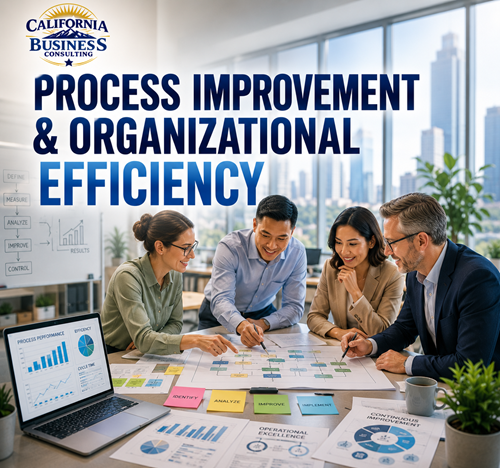
Process Improvement & Organizational Efficiency consulting helps organizations identify workflow bottlenecks, eliminate operational inefficiencies, improve productivity, and strengthen organizational performance. Effective process improvement focuses on creating practical, measurable changes that support long-term growth, profitability, and operational excellence.

Process Analysis

Workflow Optimization

Performance Improvement

Organizational Efficiency
Process Analysis
Workflow Optimization
Performance Improvement
Organizational Efficiency
Process Improvement & Organizational Efficiency
Every organization develops processes over time, but not every process continues to support efficiency, productivity, or growth. We focus on identifying workflow bottlenecks, reducing operational waste, improving resource utilization, and creating more effective systems that support long-term organizational performance.
Effective process improvement is not simply about reducing costs. We analyze how work flows through the organization, evaluate operational challenges, identify opportunities for improvement, and implement practical solutions that enhance productivity, accountability, and overall business performance.
Process Improvement Services
Business consulting services may help organizations:
- Identify workflow bottlenecks and operational inefficiencies
- Improve process consistency and organizational effectiveness
- Reduce delays, duplication of effort, and unnecessary costs
- Strengthen communication and accountability across teams
- Support sustainable growth through operational efficiency
Organizations We Commonly Support
- Healthcare organizations and medical offices
- Dental practices and professional service firms
- Small and growing businesses seeking operational improvement
Why Process Improvement Matters
- Improve operational efficiency and organizational performance
- Reduce workflow bottlenecks and operational inefficiencies
- Support sustainable growth through operational excellence
Collaborative Approach
Every organization operates differently, which is why consulting solutions should re-flect the realities of the business rather than rely on standardized recommenda-tions. The consulting process focuses on understanding operational challenges, or-ganizational priorities, performance objectives, and long-term business goals in or-der to develop practical, measurable, and sustainable strategies aligned with the organization’s needs.
Operational Assessment
Organizations often encounter operational, financial, and strategic risks during peri-ods of growth, restructuring, or changing market conditions. Strategic consulting in-volves evaluating operational challenges, identifying potential inefficiencies, analyz-ing organizational vulnerabilities, and developing practical approaches designed to support more informed decision-making, operational stability, and long-term busi-ness performance.
Implementation Planning
Business strategy and operational consulting require more than theoretical recom-mendations. Effective consulting is grounded in practical analysis, operational un-derstanding, financial evaluation, and the ability to assess how organizations func-tion in real business environments. Organizations often face operational inefficien-cies, growth pressures, communication gaps, and strategic challenges that require thoughtful evaluation and structured planning rather than generic solutions.
The consulting approach focuses on understanding organizational objectives, eval-uating operational conditions, identifying areas for improvement, and developing practical strategies aligned with long-term business performance and operational sustainability.
Continuous Improvement
Every organization operates under different financial conditions, operational struc-tures, and strategic priorities. Consulting recommendations should therefore be practical, measurable, and aligned with the realities of the organization rather than based on standardized assumptions. The consulting process focuses on under-standing operational conditions, evaluating organizational challenges, analyzing business objectives, and developing strategies that can realistically be imple-mented and measured over time.
Business strategy and operational consulting often require continuous evaluation, adaptability, and collaboration throughout the engagement process. Sustainable or-ganizational improvement is typically achieved through practical planning, opera-tional clarity, structured analysis, and consistent alignment between strategic ob-jectives and day-to-day execution.
Core Consulting Areas

Process Analysis
Process analysis focuses on evaluating workflows, identifying bottlenecks, and uncovering operational inefficiencies that may limit productivity and organizational performance.

Workflow Optimization
Workflow optimization helps organizations improve efficiency, streamline processes, reduce unnecessary steps, and strengthen operational effectiveness across departments.
FREQUENTLY ASKED QUESTIONS
Frequently Asked Questions About Process Improvement & Organizational Efficiency
What is process improvement consulting?
Process improvement consulting helps organizations evaluate workflows, identify inefficiencies, eliminate operational bottlenecks, and improve overall business performance. By analyzing how work is performed across the organization, businesses can streamline processes, improve productivity, reduce waste, and create more efficient operations that support long-term growth and profitability.
How can process improvement increase organizational efficiency?
Organizational efficiency improves when processes are standardized, resources are effectively utilized, communication flows smoothly, and unnecessary activities are reduced or eliminated. Process improvement consulting helps organizations identify opportunities to optimize workflows, improve coordination, strengthen accountability, and enhance operational performance across the business.
What are common signs of operational inefficiency?
Common indicators include workflow bottlenecks, excessive manual processes, communication breakdowns, duplicated effort, missed deadlines, inconsistent performance, rising operating costs, employee frustration, customer service issues, and declining productivity. These challenges often signal opportunities for process improvement and organizational optimization.
How does organizational efficiency affect business performance?
Organizational efficiency directly impacts productivity, profitability, employee engagement, customer satisfaction, and overall business performance. Organizations with efficient processes and clearly defined responsibilities are often better positioned to manage growth, adapt to change, and achieve strategic objectives.
Do you provide process improvement consulting for medical and dental practices?
Yes. California Business Consulting works with medical practices, dental practices, healthcare organizations, and professional service firms seeking to improve workflow efficiency, patient flow, scheduling processes, staffing effectiveness, operational performance, and organizational effectiveness. Recommendations are tailored to the unique needs of each organization.
How do you identify process improvement opportunities?
Process improvement opportunities are typically identified through workflow analysis, operational assessments, performance reviews, process mapping, staff interviews, and evaluation of key performance indicators. The objective is to understand how work is currently performed and identify practical opportunities to improve efficiency and performance.
Can process improvement support business growth?
Absolutely. As organizations grow, operational complexity often increases. Process improvement helps businesses develop scalable systems, improve coordination, optimize resource utilization, and strengthen operational infrastructure. These improvements support sustainable growth while reducing operational challenges that can limit expansion.
What is the difference between process improvement and operations consulting?
Process improvement focuses specifically on evaluating and improving workflows, procedures, systems, and operational efficiency. Operations consulting has a broader scope that may include organizational structure, staffing, performance management, resource allocation, and overall operational strategy. Process improvement is often a key component of a comprehensive operations consulting initiative.